How to Tell If Your Lawn Needs Fertilizer (And Which Kind)
Kenneth Gay
GopherTurf Owner, Licensed Lawn Care Professional
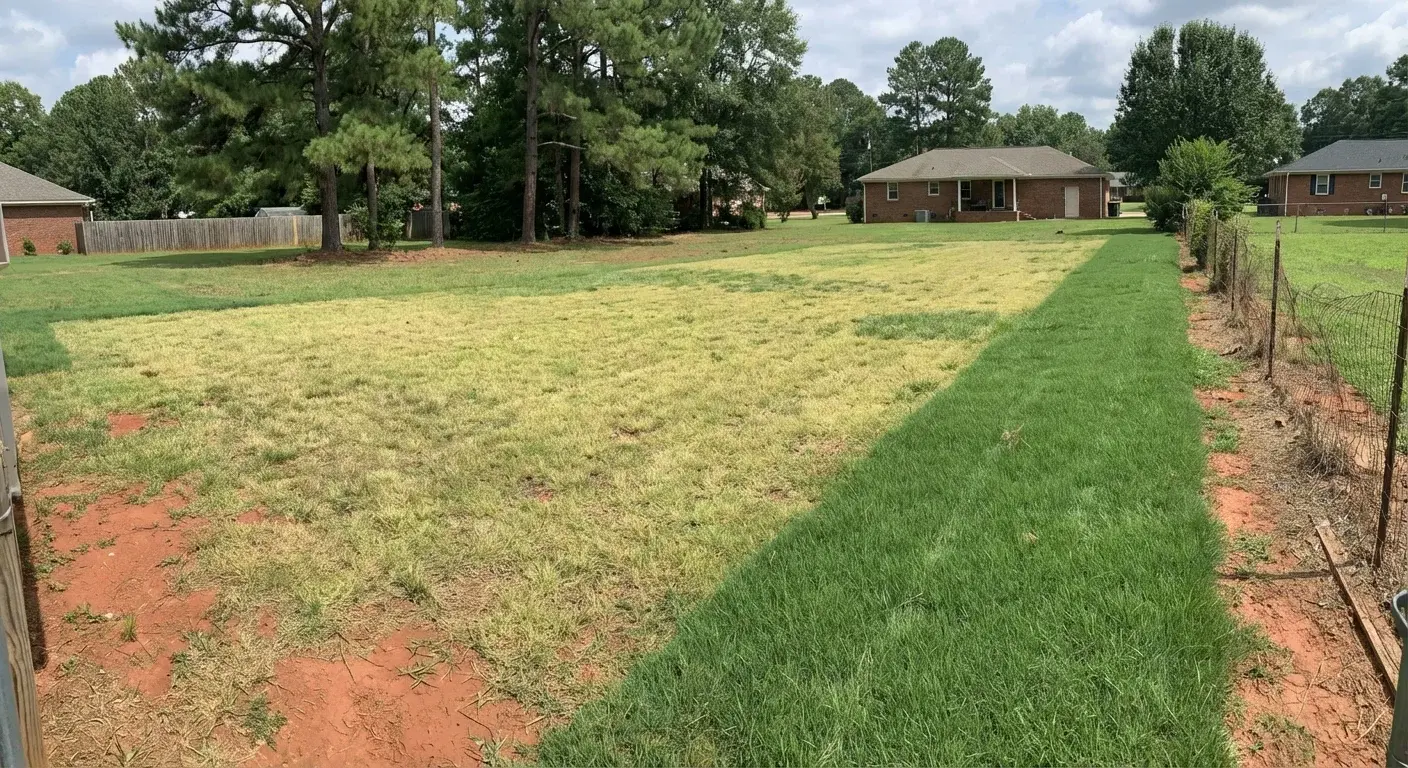
Your Georgia lawn needs fertilizer if it shows three specific signs during the active growing season (April–September): uniform pale yellow-green color across the entire lawn, slow growth that barely requires mowing, or thin sparse turf that fails to fill in despite adequate water and sunlight. These symptoms indicate nitrogen deficiency — the most common nutrient issue in Georgia's clay soils. However, brown patches, localized yellow spots, and winter browning are not fertilizer issues and won't improve with more nutrients.
Signs Your Lawn Actually Needs Fertilizer
Slow growth during active season is the most reliable indicator. If it's June and your Bermuda grass barely needs mowing every two weeks (it should need mowing every 4–5 days during peak growth), it's almost certainly nitrogen-deficient. Healthy, well-fed Bermuda can grow up to 1 inch per week during summer.
Uniform pale yellow-green color across the entire lawn — not just patches — typically indicates nitrogen deficiency. Healthy, fertilized warm-season grass should be a deep green during its growing season. The key word is "uniform" — if only certain areas are pale, the cause is more likely shade, disease, or soil variation.
Thin, sparse growth that won't fill in bare spots despite adequate water and sunlight suggests the lawn lacks the nutrients to support vigorous growth. This is common in lawns that haven't been fertilized in over a year, particularly in Georgia's clay soils where nutrients leach slowly but are consumed steadily by growing turf.
Signs That Look Like Fertilizer Deficiency But Aren't
Brown patches are more likely caused by disease (Brown Patch, Dollar Spot), drought stress, or insect damage — not fertilizer deficiency. According to the UGA Extension, adding nitrogen to a lawn with an active fungal infection actually feeds the fungus and makes the problem worse. Diagnose before you fertilize.
Yellow spots or streaks in isolated areas are typically caused by pet urine (nitrogen burn), chemical spills, or localized disease. Fertilizer won't fix these — the affected areas need targeted treatment or time to recover.
Dormant grass in Georgia is normal from November through March for warm-season varieties. Bermuda, Zoysia, and Centipede all go brown in winter. This is dormancy, not a nutrient deficiency. Fertilizing dormant grass wastes product and can actually damage the turf by stimulating growth the plant can't sustain.
Understanding Fertilizer Numbers (N-P-K)
Every fertilizer bag shows three numbers (like 16-4-8) representing nitrogen (N), phosphorus (P), and potassium (K) — the three primary macronutrients:
- Nitrogen (N): Drives green growth and leaf development. This is what most Georgia lawns need the most. The UGA Extension recommends 3–5 lbs of nitrogen per 1,000 sq ft per year for Bermuda, and 2–3 lbs for Zoysia and Centipede.
- Phosphorus (P): Supports root development and seedling establishment. Important when establishing a new lawn, but rarely deficient in Georgia's clay soils. Many Georgia counties restrict phosphorus application unless a soil test shows deficiency.
- Potassium (K): Improves stress tolerance, disease resistance, and winter hardiness. Important for fall applications to help turf survive winter dormancy. A ratio of roughly 2:1 nitrogen to potassium (like 16-4-8) is ideal for Georgia lawns.
When to Fertilize in Georgia
For Bermuda and Zoysia, the primary fertilization window is April through September:
- First application: April, after full green-up (when grass is actively growing)
- Mid-season applications: Every 6–8 weeks through summer
- Winterization: Early September with a potassium-heavy formula for stress tolerance
Three rules to follow: Never fertilize dormant grass — it can't absorb the nutrients. Never fertilize during drought — it can burn stressed turf. Never exceed the recommended rate — over-fertilization causes surge growth, increases disease susceptibility, and pollutes waterways.
The Professional Difference
GopherTurf Service Areas
We provide fertilization across central Georgia, including Pike County, Henry County, Newton County, Clayton County, Butts County, Jasper County, and Morgan County. View all service areas.
At GopherTurf, we use professional-grade slow-release fertilizers that feed your lawn steadily over 6–8 weeks, not the quick-release products that cause a green surge followed by a crash. Our formulations are calibrated specifically for Georgia's soil pH (typically 5.0–6.5) and warm-season grass types. Contact us to get your lawn on a proper nutrition program.